
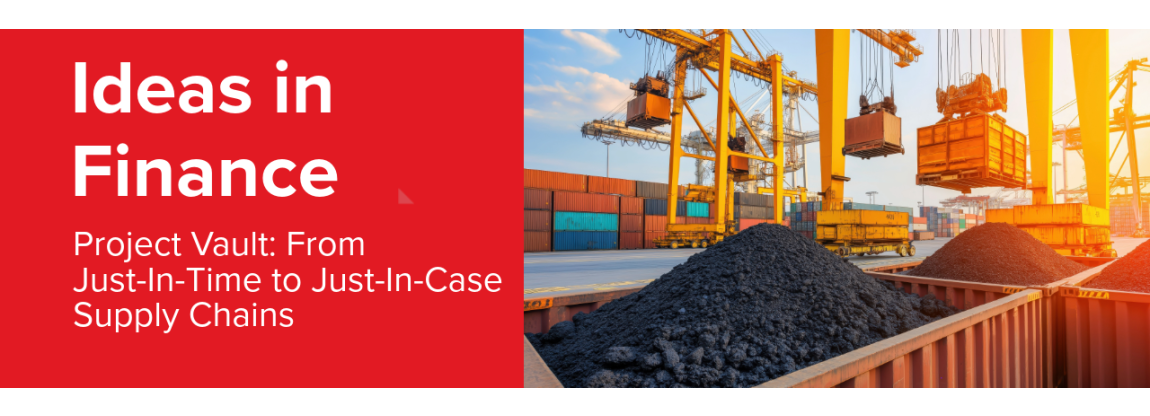
Project Vault: From Just-In-Time to Just-In-Case Supply Chains
While it will take some time for people to adjust to the reality of the situation, the era of globalisation is, at least for now, over. It was an interesting ride. Back in 1999, as a student, I was vaguely aware in that pre-social-media era, of the anti-globalisation protests that shook the World Trade Organisation (WTO) meeting in Seattle, Washington, a place I knew then only as the setting for the sitcom Frasier. Others, slightly older than me, probably associated Seattle with Kurt Cobain. In any case, it seemed like a world away. The Seattle anti-WTO protest was anticipated, however, by the anti-globalisation movements that had rattled the G-7 meetings as early as the late 1980s. Most notably, in Paris in 1989. What happened to these movements and their political allegiances in the intervening decades would make an interesting story. In any case, it is probably true to say that none of them would have imagined in 1999 that a Republican president (and a businessman no less) would oversee some of the dismantling of the arrangements established a generation ago and which they fought so strenuously against.
Looking back on it, the global supply chains that were built in the first two decades of the 21st century are stunning in their scope. If one required material such as copper, mined and processed halfway around the world, all one had to do was place an order and it would arrive. Likewise, for virtually everything else. From aspirin to television sets. This was an era that is referred to now it has passed as the “unipolar moment”, when the United States was the only global power, in control of the air and the seas. The supply chain problems that were experienced during the 2020-2022 pandemic alerted people to the fact that many of the products they needed were shipped from distant lands. Even without geopolitical tensions, this now seemed risky, possibly even foolhardy. Cheap electronics is one thing, but what about medicine? As geopolitical tensions arose and then flared into open conflict in the early 2020s, the tenuousness of the global supply chain seemed even more obvious.
In early February 2026, Donald Trump announced Project Vault. Like the idea of a strategic petroleum reserve (interested readers can check on Australia’s reserves, especially where they are located), Project Vault is a reserve of critical minerals, such as cobalt. The project is established with $2 billion of private capital, invested by companies such as Boeing and Google, plus a $10 billion loan from the Export-Import Bank. It is more than just a stockpile, however. It is something more akin to a government-business cooperative, designed to smooth prices in certain minerals. The participating firms commit to purchase a certain quantity (later) of the minerals they need for their products. They pay a fee upfront. Project Vault then obtains and stores those minerals. Companies then access those minerals at the pre-agreed prices, replenishing stocks as they are used. During an emergency, the entire stockpile is available.
Schemes such as this are consistent with the pro-manufacturing, re-shoring concepts that have become banners in the contemporary political landscape, but as we have seen at the outset, this taps into feelings, some long dormant, that were more openly on display throughout the 1990s. Going forward, the idea of just-in-time inventories, where no more than the absolutely necessary amount of raw materials and finished goods were kept on hand, regardless of where in the world the raw materials or finished goods were made, mined, processed, or shipped from, will increasingly be replaced with just-in-case inventories, where reserves are managed and, potentially, manufacturing moved closer to home, if not all the way home.
Discussion Questions
1. What is the US Export-Import (EXIM) Bank?
2. What happened at the WTO meeting in Seattle in 1999?
Read more Ideas in Finance
Young Investors Seeking Dividends
The Velocity of Money and Central Bank Digital Currencies
Should You Want Interest Rates to Fall?
What’s Going on with the Chinese Economy?
Is it Negative Gearing or Monetised Housing?
Set the Interest Rate at Zero. Why Not?
The Commodity Research Bureau (CRB) Index and Australian Inflation
The Disagreement between Elon Musk and Donald Trump: The Simplest Explanation?
Tariffs and Retaliation: No Simple Answers
Housing: Where is the Money Coming From?